
Rupee vs Dollar: The Hidden Mechanism No One Explains!

Most people think the INR keeps falling because India imports more than it exports. Some say it’s inflation, others blame weak policies.
But here’s the twist: all these silly reasons only scratch the surface.
The real story of INR vs USD isn’t about import-exports alone, it’s about the hidden design of the global financial order.
When you walk into a shop in India, every price tag is in rupees. But when you step into global trade, suddenly every deal is measured in dollars.
It’s like playing a cricket match where the scoreboard belongs to the other team. You can bat brilliantly by hitting fours and sixes, yet the numbers never favour you.
Most explanations you hear about the rupee’s fall sound repetitive. Economists say, “India imports more than it exports” or “inflation weakens the currency.” These are not wrong, but they are incomplete. They explain the symptoms, not the system.
Unless you truly understand the hidden reason why INR keeps sliding against USD, you’ll always be left wondering. You’ll see headlines of the rupee “falling to record lows” year after year, and you’ll think it’s natural. But here’s the twist: even when the rupee stops falling or temporarily rises, without this understanding, you still won’t grasp why it happened.
Currencies don’t just move because of trade numbers or inflation. They move within a global order, a design that silently decides which currencies remain strong and which ones keep weakening. And unless you see this mechanism clearly, the rupee-dollar story will always feel like a mystery.
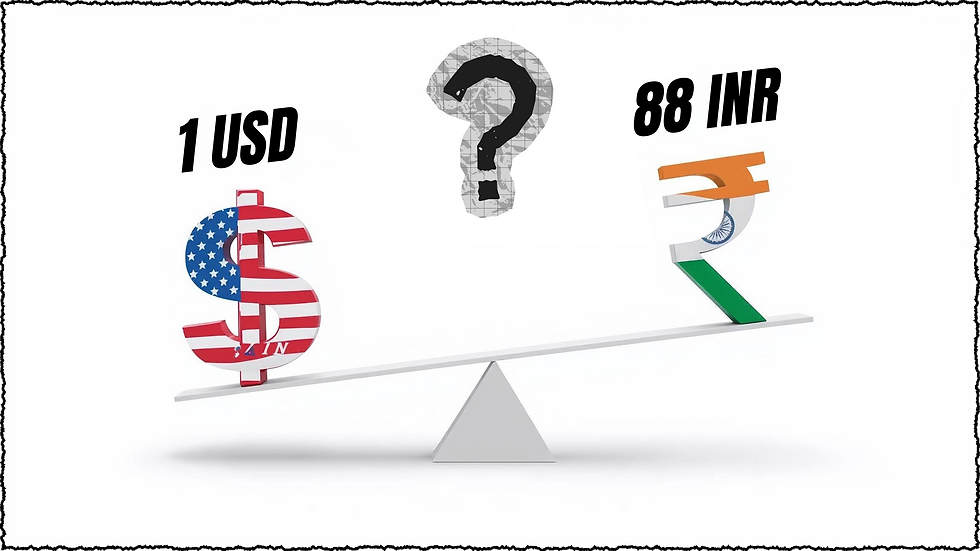
In this article, I will explain that hidden mechanism, a practical, real-world reason why the rupee seems programmed to lose against the dollar. Once you see it, the ups and downs of INR vs USD will finally make sense.
Why Governments Print IOUs Instead of Money?
IOU literally means “I Owe You.”
In finance, when we say governments issue bonds as “IOUs,” it means the bond is a formal promise by the government to repay borrowed money with interest at a later date.
To grasp this explanation, one must first understand why governments raise debt through bonds, and why these bonds are considered free from default risk yet carry the risk of currency devaluation.
Governments, like individuals, spend more than they earn. Politicians aim to stay in power, and the easiest way to do that is by pleasing people through welfare schemes, infrastructure projects, subsidies, tax cuts, and military spending. But the income (mainly from taxes) usually falls short of these high expenses.
To cover this gap between income and expenditure, governments borrow money.
The main way governments borrow is by issuing bonds. A bond is essentially an IOU. Investors lend money to the government by buying these bonds, and in return, the government promises to pay back the amount with interest.
These investors can be:
Domestic citizens or institutions
Foreign governments
Central banks
Large financial entities
For example, if the U.S. government wants to borrow $1 trillion, it might issue Treasury Bonds offering, say, 3% annual interest. Investors buy these bonds, and the government uses that money to fund its deficit.
What Happens Over Time
But here’s where the debt cycle starts.
As the government continues borrowing year after year, its total debt accumulates. At some point, investors begin to question whether the government can repay it easily. If there’s too much supply of bonds (more debt) and not enough demand, bond prices fall, and interest rates must rise to attract new buyers.
Higher interest = higher cost of borrowing = even more future debt.
The Role of Inflation and National Income
Interest rates on bonds are also influenced by:
Inflation: If inflation is high, the bond's real return falls. So investors demand higher rates to compensate.
National income (GDP): A strong economy can support higher debt. But if GDP growth slows, the debt burden looks heavier, and again, investors demand higher yields.
The “Printing Money” Escape Hatch
When debt becomes unmanageable, and there's no one willing to buy bonds at reasonable interest rates, the government turns to its central bank.
The central bank "prints" money (digitally creates currency) to buy the bonds. This injects cash into the system and helps pay off debt.
This works only if the debt is in the government’s own currency, like:
USD for the U.S.
INR for India
JPY for Japan
So, there's no risk of default, but there is a risk of currency devaluation as printing more money can reduce the currency’s value and lead to inflation.
Example: Japan

Japan is a textbook example. It has one of the highest debt-to-GDP ratios in the world (over 250%). Yet, it hasn’t defaulted.
Why?
Because most of its debt is held domestically, and the Bank of Japan has bought a huge portion of it by printing yen. So there’s no default risk—but the value of the yen has steadily weakened over the years, especially against the dollar.
Ray Dalio would call this the "long-term debt cycle" in motion. Governments borrow to fund promises, interest payments compound over time, central banks step in, money is printed, and eventually you either grow your way out (via productivity) or inflate your way out (via currency devaluation).
Interest Rates Reflect a Country’s Fundamentals
The interest rates of a country like the Fed Rate in the U.S. or the Repo Rate in India aren’t set randomly. They reflect a hierarchy of internal economic conditions in this order:
Income (GDP growth & productivity)
Debt levels (public + private)
Government spending (deficits)
Inflation
Countries with strong income, manageable debt, disciplined spending, and low inflation can afford lower interest rates. Conversely, countries with less reliable income, more debt, and higher inflation must offer higher interest rates to attract capital.
Take the current situation:
U.S. Federal Funds Rate: ~4.25%
India Repo Rate: ~5.5%
India’s higher rate reflects:
Higher inflation risk (typically 5–6% vs. U.S.'s 2–3%)
Higher government deficits
A developing economy with greater perceived risk
The U.S., with a more stable economy and reserve currency status, attracts global capital even at lower rates.
The Interest Rate Parity & Currency Valuation
Here’s the core principle:
If one country’s bonds yield more than another’s, investors would flock to the higher-yielding bonds, right?
But it’s not that simple and here’s why.
Let’s say India’s bonds yield 1.25% more than U.S. bonds (5.5% vs. 4.25%).
If the Indian Rupee and U.S. Dollar were expected to remain stable, global investors could borrow in USD, convert to INR, buy Indian bonds, and pocket a near risk-free profit.
But in global finance, there’s no free lunch.
To balance this arbitrage opportunity, the currency of the higher-interest-rate country (INR) is expected to depreciateagainst the currency of the lower-interest-rate country (USD) by approximately the interest rate differential—in this case, ~1.25% annually.
This concept is known as Interest Rate Parity.
A Real-World Example: U.S. vs India (2013)

In 2013, U.S. interest rates were extremely low—near 0.25%—following the 2008 financial crisis and quantitative easing.
India’s repo rate back then was around 7.25%.
So the interest rate differential was roughly 7%.
What happened?
The INR depreciated significantly from around INR 55/USD in mid-2012 to INR 68/USD in mid-2013.Why? Investors were chasing yield in emerging markets like India, but once the Fed signaled tapering (reduced money printing), money flowed back to the U.S., leading to a sharp fall in the Rupee.
This fall neutralized the interest advantage of Indian bonds.
Bottom Line
Interest rates aren’t just tools for local monetary policy—they’re signals about a country’s financial strength, risk profile, and inflation control.
Whenever a country offers higher interest than another, its currency is expected to weaken to offset the yield advantage, ensuring that global capital doesn't flow in blindly. This self-adjusting mechanism maintains global financial equilibrium—until, of course, something breaks.
This is the primary reason why INR always falls against USD.
What If the Currency Doesn't Offset the Interest Rate Gap?
Imagine two countries:
Country A: Has low interest rates (say 3%)
Country B: Has high interest rates (say 6%)
Normally, investors would expect Country B’s currency to fall by the same 3% per year. Why? Because that would cancel out the higher interest rate and make returns from both countries about the same.
But what if that doesn’t happen?
What if Country B gives 6% interest, and its currency is only expected to fall 2% per year?That means you still earn some extra % return every year.
This is like free money, virtually risk-free.
So what happens?
Investors around the world would start:
Selling bonds and currency of Country A (low returns)
Buying bonds and currency of Country B (higher returns)
But this can’t go on forever. The market must adjust, or big imbalances build up. Here’s how it usually fixes itself:
Two Things Can Happen (or Both):
1. The currency of Country A falls sharply
To rebalance, Country A’s currency could drop all at once—maybe by 40%—to make its bonds less attractive and stop the rush of money leaving.
2. Country A raises its interest rates
If it increases rates by 5%, suddenly its bonds yield 8%, and the advantage disappears. But bond prices fall when interest rates go up, so bondholders lose 40%.

If Neither Happens (Say There Are Capital Controls)
In some countries, you can't easily move money in or out (like some emerging markets). In that case, the imbalance persists.
So if you’re holding Country A’s bonds:
You earn 3% less interest
The currency still falls 2% a year
That’s a 5% total loss every year compared to holding Country B’s bonds.
Over 10 years, that loss compounds to about 40%, meaning your wealth shrinks massively just because you were stuck with the lower-return investment.
In global markets, interest rates and currency movements are deeply connected.
If the math doesn’t add up, investors will find and exploit the gap. And when they do, the system is forced to adjust—through currency crashes, interest rate spikes, or massive capital losses.
It’s all one big balancing act.
Caution: Please note in reality, Uncovered Interest Rate Parity (UIP) often does not hold perfectly in real markets due to risk premiums, capital controls, and differing expectations, so currency depreciation does not always exactly match the interest rate gap exactly.
How Many Investors Aim to Benefit from Global Interest Rate and Currency Differences?
Understanding how interest rate gaps and currency movements work has led many investors to adjust their portfolios accordingly.
While these are not guaranteed strategies, here are some common approaches investors use to respond to such macroeconomic dynamics:
1. Gaining Exposure to International Bonds via Funds
Many investors choose to invest in international bond ETFs or mutual funds to capture higher yields in countries with relatively higher interest rates. These funds may be:
Hedged: to reduce currency risk
Unhedged: for those willing to accept currency fluctuations
📌 Example behavior: When interest rates in emerging markets are higher than in developed markets, some investors allocate capital to funds that track bonds in those regions.
2. Holding Foreign Currency Deposits
Certain investors use foreign currency savings accounts or fixed deposits to take advantage of higher interest rates offered in other countries. This may involve currency risk, as the value of the held currency can fluctuate.
📌 Example behavior: When domestic rates are low, some savers shift part of their capital into USD, INR, or other currency-denominated accounts offering higher returns.
3. Using Currency ETFs or Forex Products
Some investors, particularly those with more experience in macroeconomics, trade in currency ETFs or forex marketsto speculate on or hedge against currency movements linked to interest rate differences.
📌 Example behavior: When one country is raising rates and another is keeping rates low, certain investors may take positions that benefit from the currency of the higher-rate country strengthening.
4. Monitoring Central Bank Policies
Central bank actions—like rate hikes, cuts, or currency interventions—play a major role in shaping global investment flows. Many investors regularly monitor such developments to adjust their expectations.
📌 Example behavior: Some investors watch the U.S. Federal Reserve, Reserve Bank of India, or European Central Bank to anticipate how interest rate decisions might impact bond markets and currencies.
Summary
While these approaches involve varying levels of risk, they illustrate how interest rate gaps and currency trends influence investment decisions around the world. Many investors use them to manage exposure, seek better returns, or diversify their portfolios.
Disclaimer
I am personally fascinated by these concepts and currently studying them in greater depth. These articles are essentially my notes for further learning, and while I’ve tried to explain them clearly, I cannot guarantee that everything here is 100% accurate or complete. Nothing in this article should be taken as investment advice or a recommendation to buy or sell any financial product. This is purely for educational and exploratory purposes.


The mobile interface of https://bdmelbet.net/ is exceptionally well-executed. It doesn't feel like a scaled-down version of a desktop site, but rather a purpose-built mobile experience. Navigating through the different sections is fluid and requires very little effort